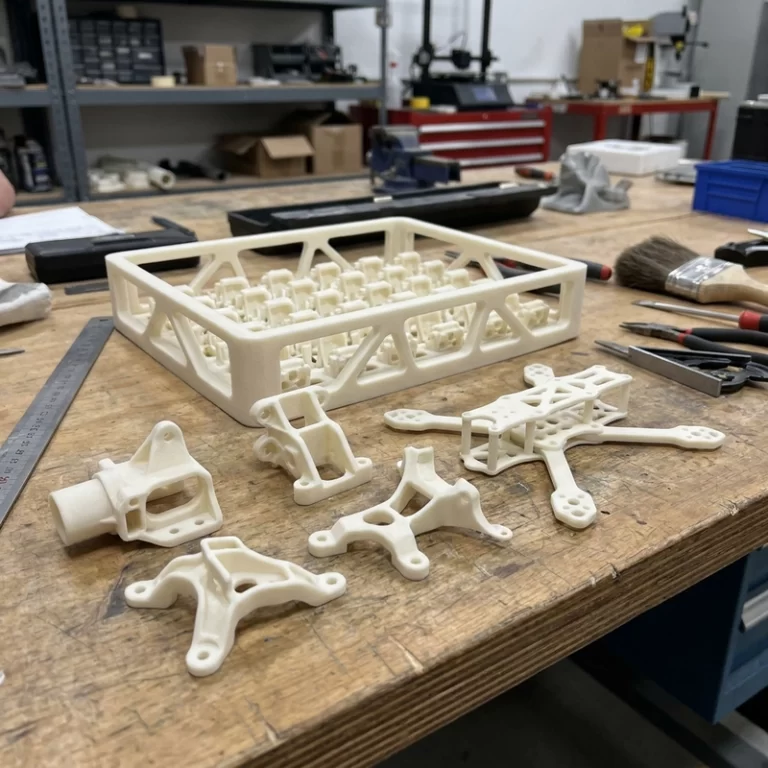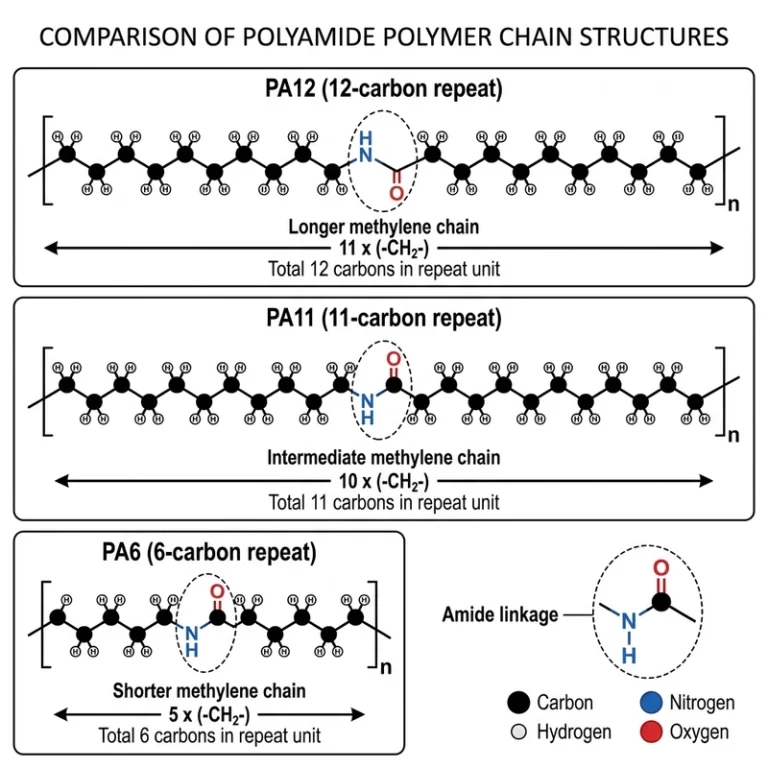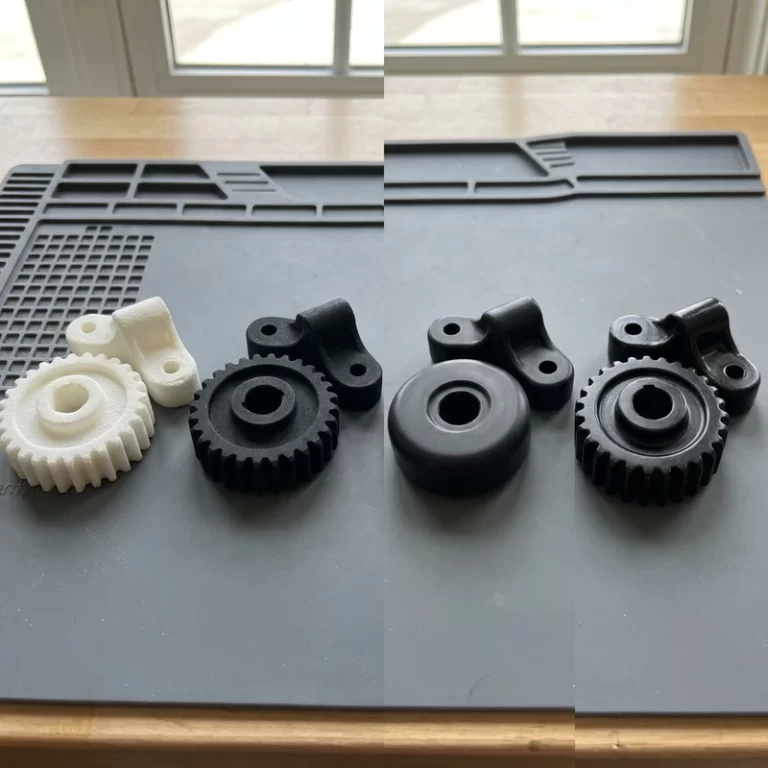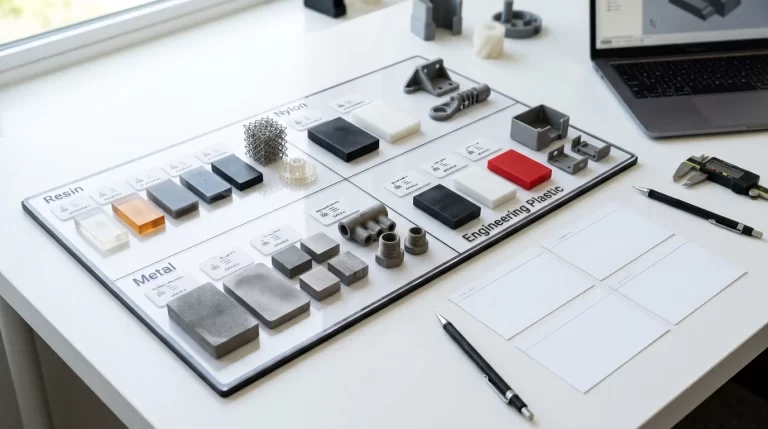
If you’re choosing between PA11 and PA12 for SLS or MJF, you’re really deciding between a ductile, impact-friendly material and a stiff, dimensionally stable one. Both are nylon powders, both print without support material, and both are perfectly good engineering plastics. But they behave differently in service, and picking the wrong one usually shows up as cracked clips, failed snap fits, or a part that’s stiffer (or flexier) than you wanted.
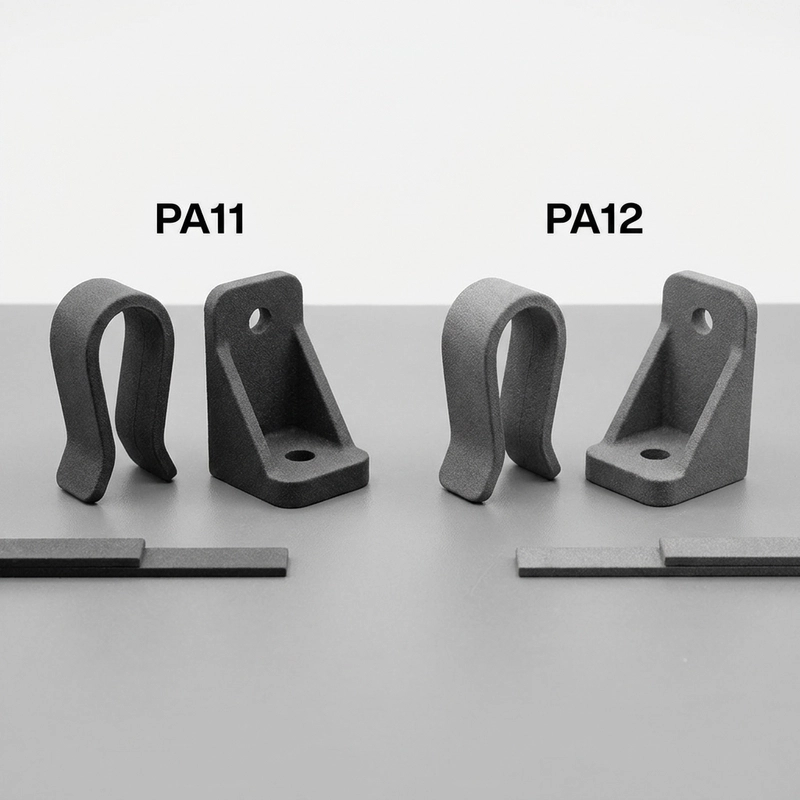
Here’s how I decide, based on what the part actually has to do.
PA12: The Default Choice (and Usually the Right One)
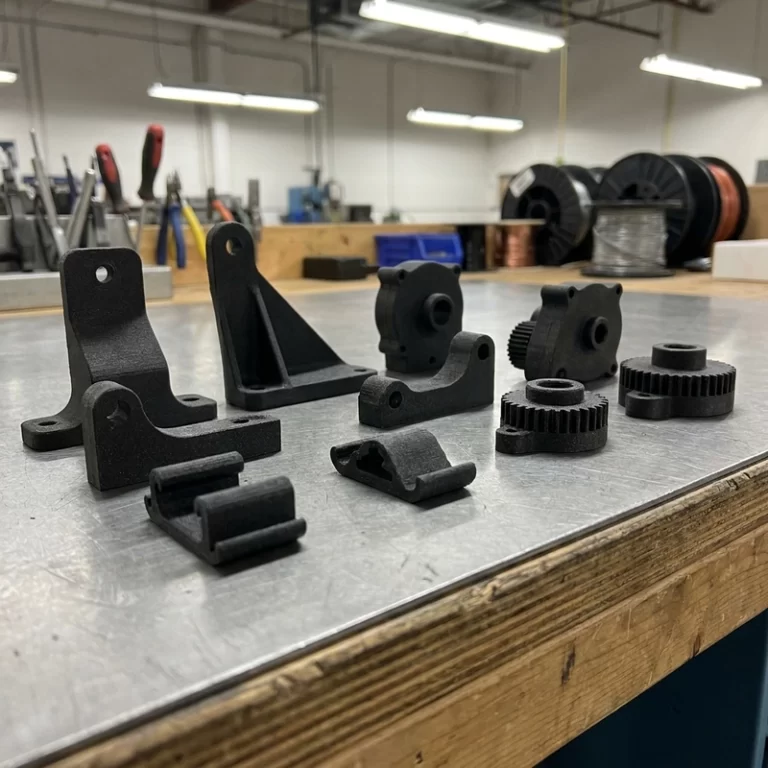
PA12 is the workhorse. It’s widely available, prints reliably on both SLS and MJF, has good dimensional stability, and costs less than PA11. I spec PA12 for most housings, brackets, ducts, jigs, fixtures, and functional prototypes where the part needs to be stiff and hold shape.
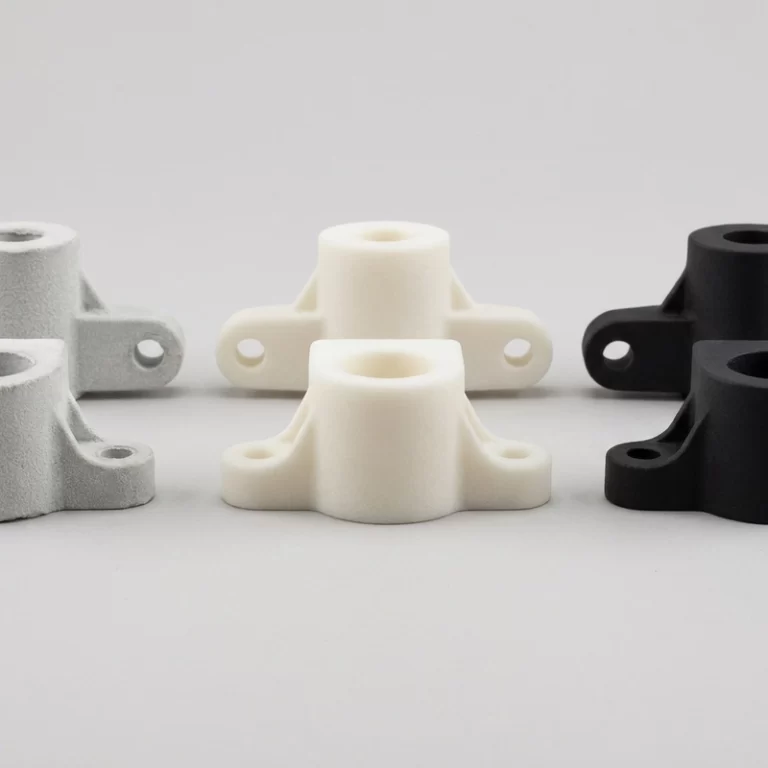
The surface is powdery out of the bed. Bead blasting cleans it up. Dyeing (usually black) gives a more uniform look. Tumbling smooths edges. PA12 is well-documented and most suppliers know how to process it reliably.
PA12’s weakness is impact and repeated flex. It’s not brittle—it handles normal handling fine—but it’s not the material for a clip that gets actuated 1000 times or a part that takes repeated drops.
PA11: When the Part Needs to Bend or Take a Hit
PA11 is more ductile and has better impact resistance. It’s the right choice for:
- Snap fits or clips that need to flex repeatedly without cracking
- Parts that take drops or impacts in service
- Living-hinge-style features (within limits—printed nylon is still nylon)
- Protective components or enclosures that need toughness more than stiffness
- Applications where a bio-based material story matters (PA11 is often derived from castor oil, not petroleum)
The tradeoff: PA11 typically costs more and may have longer lead times. It also needs its own process validation—don’t assume the PA12 process window works for PA11 without checking.
| Decision factor | PA12 | PA11 |
|---|---|---|
| Stiffness / dimensional stability | Better | Good, but more compliant |
| Impact resistance / ductility | Moderate | Better |
| Cost and availability | Lower cost, widely available | Higher cost, may be limited |
| Bio-based content | Petroleum-based | Often bio-based (castor oil) |
| Print process maturity | Very mature, widely documented | Mature but less universal |
Design Rules Still Apply to Both
Neither material removes the need for good design. Clips need large radii at the bend. Thin walls need enough thickness for depowdering. Holes may need post-drilling for roundness. Internal channels need powder escape paths. I’ve seen PA11 parts fail not because of the material but because the wall was 0.6 mm thick and the designer assumed “ductile” meant “can be arbitrarily thin.”
For material selection broader than PA11/PA12, consider filled nylons (glass, aluminum) or TPU if you need even more flexibility.
Finishing: Test on the Actual Material
PA11 and PA12 finish differently. Dyed PA11 can come out slightly different in color than dyed PA12. Tumbled PA11 may feel slightly different because the base surface is different. If the part is consumer-facing, approve finish samples on the actual material, not on “nylon in general.”
Also: tumbling rounds edges. If you have sharp features or fine text, tumbling may soften them. For PA11 clips or snap fits, tumbling can remove the very clearance you designed in. Check finished samples before committing to a finish route for a batch.
RFQ Checklist: PA11 vs PA12
- Part function: rigid (PA12) or flex/impact (PA11)?
- Snap fits, clips, hinges: if yes, lean PA11 unless the stress is very low.
- Sustainability requirement: bio-based PA11 may matter for brand or compliance.
- Budget and lead time: PA12 is faster and cheaper in most markets.
- Finish: raw, dyed, tumbled, sealed? Approve samples on actual material.
- Validation: for critical parts, print and test a coupon in the actual orientation before batch.
PA11 and PA12 are both good choices. The right one depends on what the part does, not on which one has the higher tensile strength number on a datasheet. Match the material to the job, and the part will work. Pick based on a spec sheet alone, and you may be reordering sooner than you planned.