CLIP resin 3D printing is often described as fast resin printing, but that shortcut hides the important part. CLIP changes how the part separates from the vat window. Instead of curing, peeling, recoating, and repeating layer by layer, it uses an oxygen-permeable window to keep a thin uncured zone below the growing part.
That oxygen-inhibited zone is the heart of the process. If it is stable, the part can rise continuously through liquid resin. If it is not stable, speed turns into sticking, distortion, heat buildup, or weak detail.
CLIP resin 3D printing depends on the oxygen dead zone
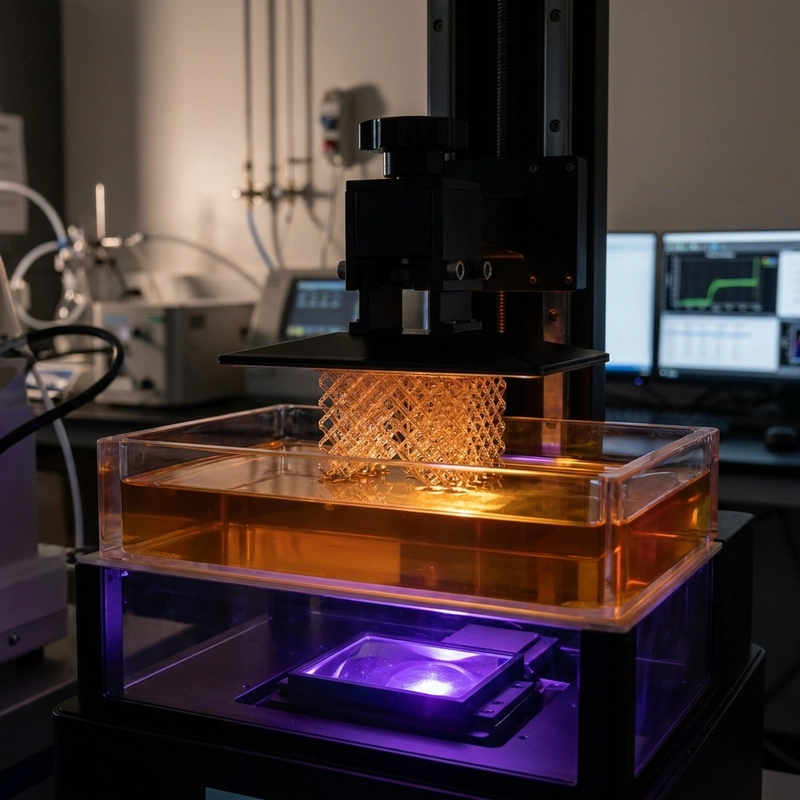
In conventional SLA or DLP, each layer separates from a film or window. That peel step creates force and time delay. CLIP uses a window that allows oxygen to pass through. Oxygen inhibits free-radical polymerization near the window, so resin in that thin zone stays liquid while light cures resin just above it. The part grows continuously rather than stopping after every layer.
The dead zone cannot be treated as a marketing detail. Too thin or unstable, and the part may stick. Too thick, and fine detail or dimensional accuracy may suffer. Resin chemistry, light dose, oxygen transport, heat, and lift speed all have to match. It is not a normal resin printer with the speed number raised.
Where CLIP resin 3D printing can save time
The speed advantage comes from removing repeated peel and recoat delays. The source referenced a 10 cm model that could shift from hours in a traditional layer process to tens of minutes in a suitable continuous process. I would not quote that as a guarantee. Real speed depends on part height, cross-section, resin viscosity, heat generation, support needs, and cleaning access.
Large solid cross-sections may need slower movement because heat and resin flow become limiting. Thin tall features may need support. Hollow parts need drainage. A fast build is not useful if the part warps during washing or shifts dimension after post-curing.
| Process factor | CLIP advantage | Practical limit |
|---|---|---|
| Layer separation | Continuous lift reduces cycle delay | Dead zone must remain stable |
| Surface texture | Fewer stop-start artifacts | Resin shrinkage still matters |
| Fine detail | Projection can hold small features | Overcuring can close gaps |
| Batch speed | Good for suitable resin geometry | Heat, viscosity, and supports may slow it |
| Material behavior | Engineered resins are possible | Properties remain resin-dependent |
CLIP is still resin manufacturing
SLA, DLP, and CLIP all cure photopolymer resin with light. CLIP can reduce some layer artifacts and build faster for suitable parts, but it does not remove resin limitations. Photopolymers may be brittle, UV-sensitive, heat-limited, or affected by post-cure. A resin that prints quickly may still be wrong for snap fits, outdoor use, high temperature, or chemical exposure.
Support strategy also remains real. The image of a part rising cleanly from resin does not mean every island, cantilever, heavy section, or cosmetic face can print unsupported. Supports, washing, and curing still decide surface quality and final size.
CLIP resin 3D printing inspection notes
I measure resin parts after the full process, not immediately off the platform. Washing, solvent exposure, drying, and UV post-curing can change size and brittleness. For repeated parts, compare first, middle, and last pieces if the build is long enough for resin temperature or projection behavior to drift. For broader resin process context, see SLA resin 3D printing and black SLA resin 3D printing.
The original CLIP paper in Science is still a useful primary reference for the process principle. My shop-side rule is simpler: use CLIP when speed, resin material, geometry, support, and post-curing all fit the job. CLIP resin 3D printing is fast only when the whole workflow can keep up.
For a first run, I would check more than build time. I would look at unsupported edges, internal drainage, heat-sensitive thick sections, support scars, and whether the resin feels fully cured after the normal post-cure cycle. A fast green part that needs slow rework is not a fast finished part. This is especially true for small production runs where every part needs the same appearance and fit.
I also keep conventional resin options on the table. Standard SLA or DLP may be slower, but they can be easier to source, easier to validate, or better matched to a specific resin. CLIP resin 3D printing earns its place when the continuous process improves the actual project, not when speed is the only line in the quote.
For small-batch approval, I would ask how consistency is checked across repeated runs. Projection output, resin age, temperature, and post-cure settings can all shift. A continuous process can remove one bottleneck and still leave normal resin manufacturing risks in place. Those risks should be visible in the quote and inspection notes.
If the part has snap features or thin walls, I would test them after the full cure cycle, not while the resin still feels fresh.