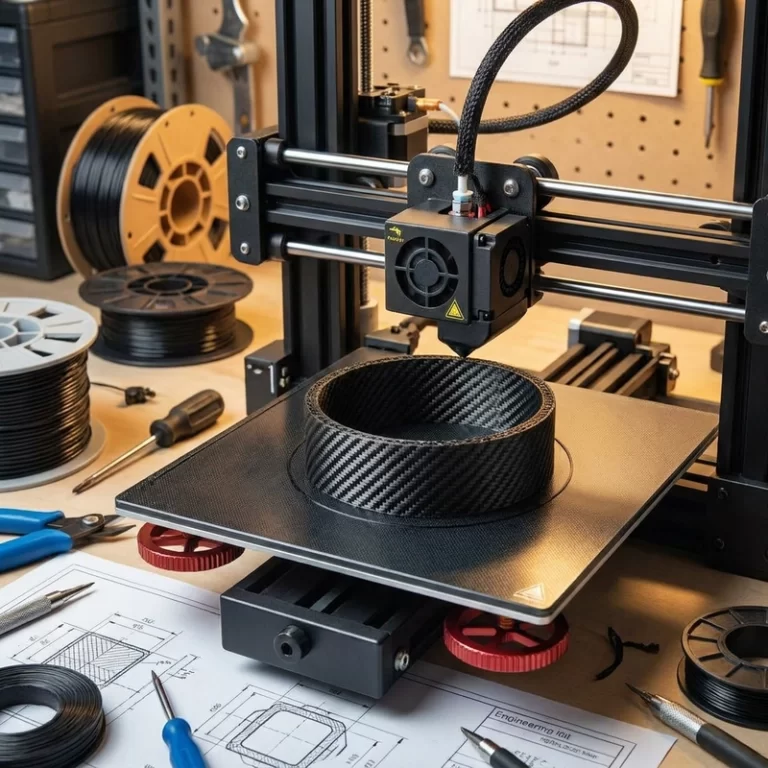
PLA 3D printing strength is easy to overestimate because PLA feels stiff and prints cleanly. A part can look sharp, hold its shape on the bench and still crack suddenly when bent, dropped, warmed or loaded across layer lines. The issue is not that PLA is bad. The issue is that stiffness, toughness, tensile strength and heat resistance are not the same property.
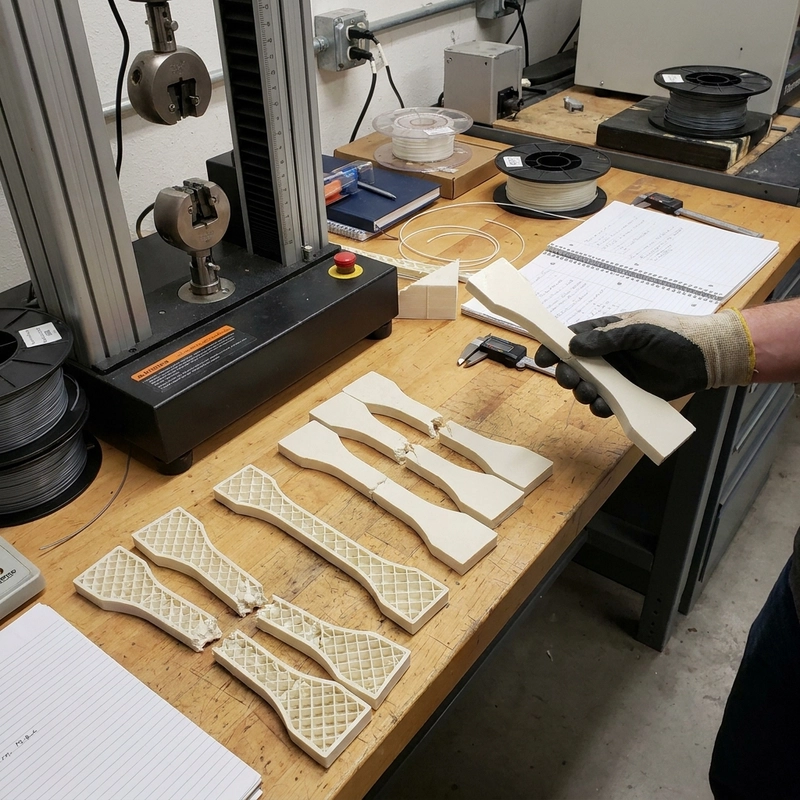
PLA is useful for visual prototypes, educational models, casting patterns, fit checks and light-duty jigs. It becomes risky for snap fits, living hinges, moving joints, hot environments, outdoor brackets and impact-loaded parts. To use PLA responsibly, the design needs to compensate for brittleness, layer anisotropy and low heat resistance.
PLA 3D Printing Strength Feels Different From Toughness
PLA’s stiffness is the reason it feels strong during casual handling. It resists bending at first. Then it can fail sharply at a thin wall, hook root, screw boss, notch or layer boundary. A PETG or nylon part may deform before breaking; PLA may give less warning. This matters for clips and brackets because the first assembly cycle may already be the highest stress event.
Heat is the other limit. PLA softens at lower temperatures than ABS, PC or many nylons. A part left in a hot car, near a motor, under a lamp or inside warm equipment can lose stiffness. A desk test at room temperature is not enough when the real part sees heat. For a broader material comparison, read engineering plastic 3D printing material selection.
Impact is where PLA surprises people. A fixture can pass a slow hand load and then chip when dropped on a corner. A tab can survive one assembly and crack on the second because the first bend already created a tiny notch. If the part must clip, flex, vibrate or survive shipping abuse, I start looking at PETG, ABS, nylon or a modified PLA before increasing infill.
Infill Is Not the First Fix
Increasing infill can improve stiffness and compression behavior, but it does not fix weak walls, sharp corners or bad orientation. A part with thin outer walls and high infill can still crack at the shell. More perimeters, local ribs, fillets and better load-path orientation often do more than pushing infill higher across the whole model.
Infill pattern also needs context. Grid or triangular patterns can be useful for balanced stiffness. Gyroid can distribute load smoothly in some parts. But if the part has a known load direction, reinforce that path with walls and geometry, not only a hidden slicer pattern. For general strength logic across materials, compare with 3D printed part strength.
Screw bosses are a common weak point. A self-tapping screw can split a thin PLA boss even when the outside shell looks strong. Add wall thickness around the boss, use a pilot hole, consider heat-set inserts where temperature allows, and avoid placing the boss so layer lines peel apart under tightening. If a screw must be removed and installed many times, plain PLA is rarely my first choice.
Orientation Controls PLA 3D Printing Strength
FDM parts are anisotropic. Strength along extrusion roads is different from strength between layers. For PLA, brittle failure can follow the layer boundary quickly. A hook printed so the load peels layers apart may fail far earlier than the same hook printed with continuous strands along the load. The best orientation for strength may not be the prettiest orientation.
Geometry beats material marketing. Add fillets at internal corners. Round snap roots. Use ribs instead of making the whole part chunky. Avoid tall thin posts with tiny bases. Increase local material around screws and bearing surfaces. Print a small coupon for snap features, hinge roots or loaded tabs before printing the whole assembly. If the part has motion, the article on 3D printed moving joints is worth checking before choosing PLA by habit.
Modified PLA, Annealing and Recycled Material
PLA+ and impact-modified grades can be tougher, but supplier behavior varies. Some trade stiffness, dimensional accuracy or heat behavior for impact resistance. PLA blended with a small TPU phase may improve impact toughness, but too much soft material changes stiffness and extrusion behavior. Annealing can improve heat resistance, but it can also shrink or warp the part. PLA may shrink around 0.1-0.3% in ordinary printing, and annealing can add more dimensional movement.
Recycled PLA needs consistency control. The source suggests blending new and recycled PLA rather than using recycled material alone, with a 3:1 new-to-recycled ratio as one practical starting point when consistency matters. Moisture, contamination, colorant and heat history all change extrusion. The NIST additive manufacturing page is useful for process context, but PLA 3D printing strength still needs real coupons when the part is functional. If heat, impact, flexing or wear matter, choose another material before the brittle failure teaches the lesson for you.
For RFQ notes, describe the real abuse rather than asking for “strong PLA.” Say whether the part is visual, load-bearing, clipped together, screwed together, used outdoors, exposed to heat or shipped assembled. PLA 3D printing strength can be enough for the right part. It just needs an honest use condition instead of a vague strength label.