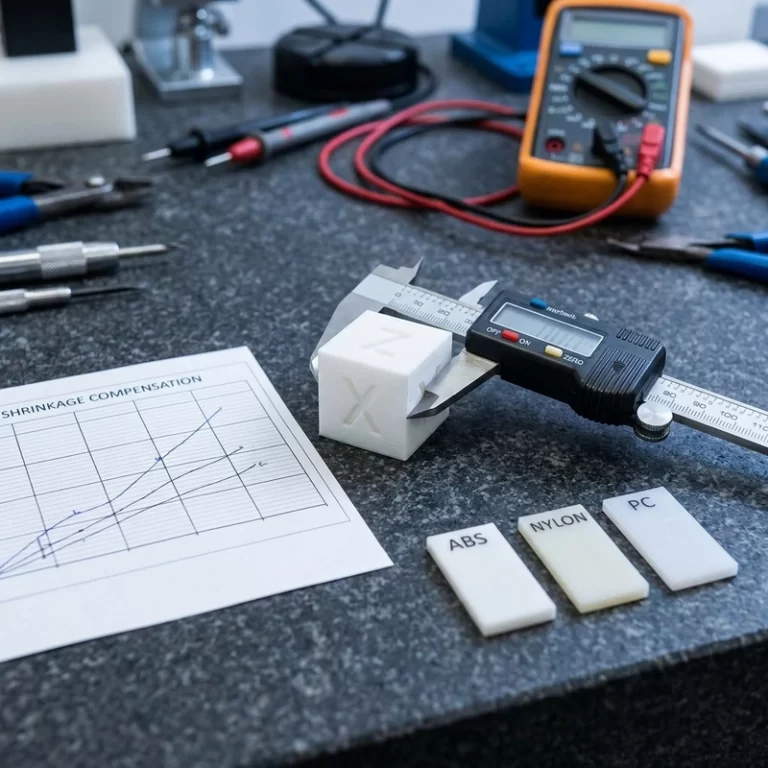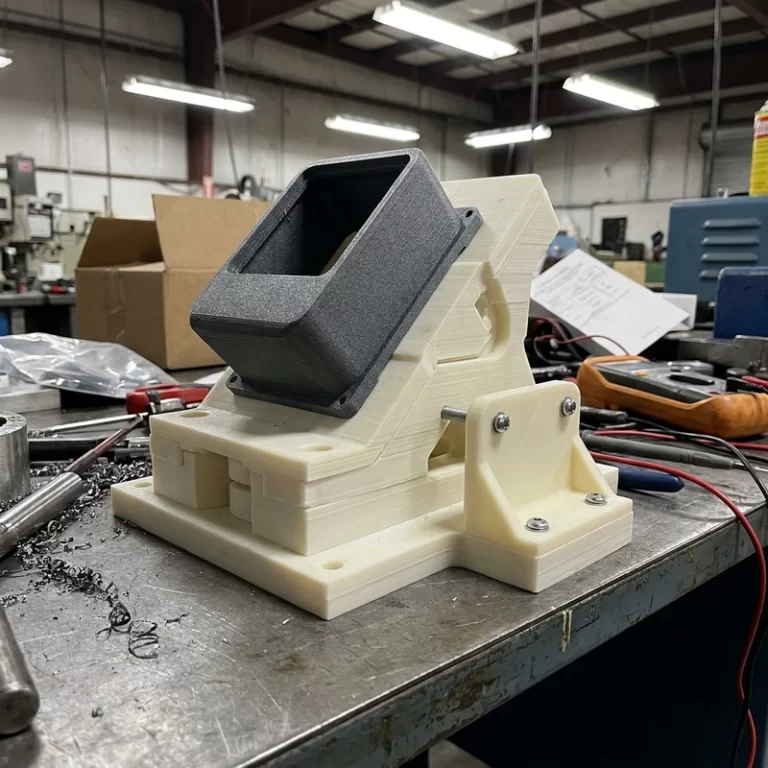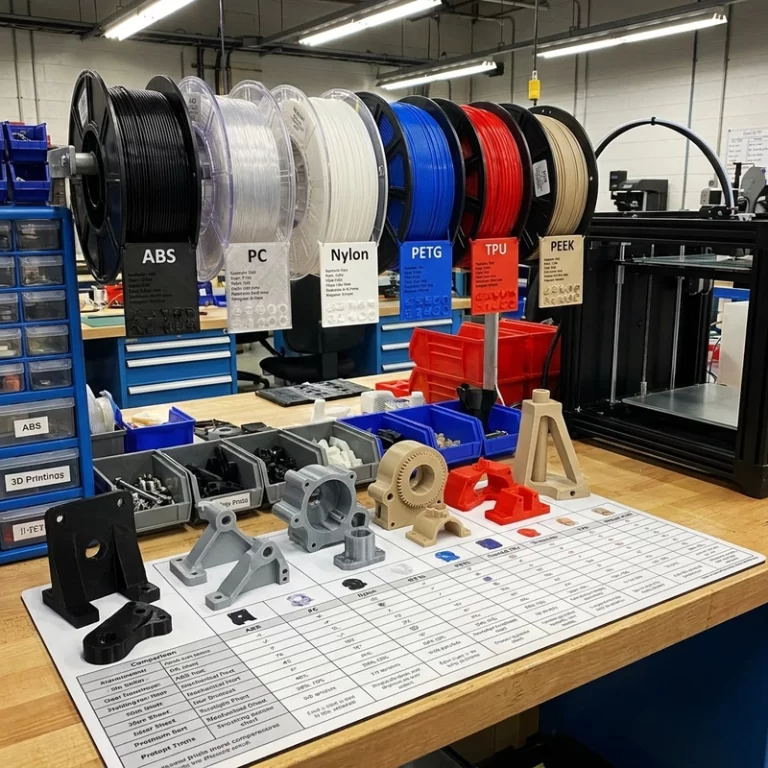
Engineering plastic 3D printing cost is not just the price of filament or nylon powder. The real number includes machine time, failed builds, drying, support removal, sanding, coating, inserts, inspection, packing, and the cost of changing the design after the first sample. When people compare 3D printing with injection molding, they often compare the wrong line items.
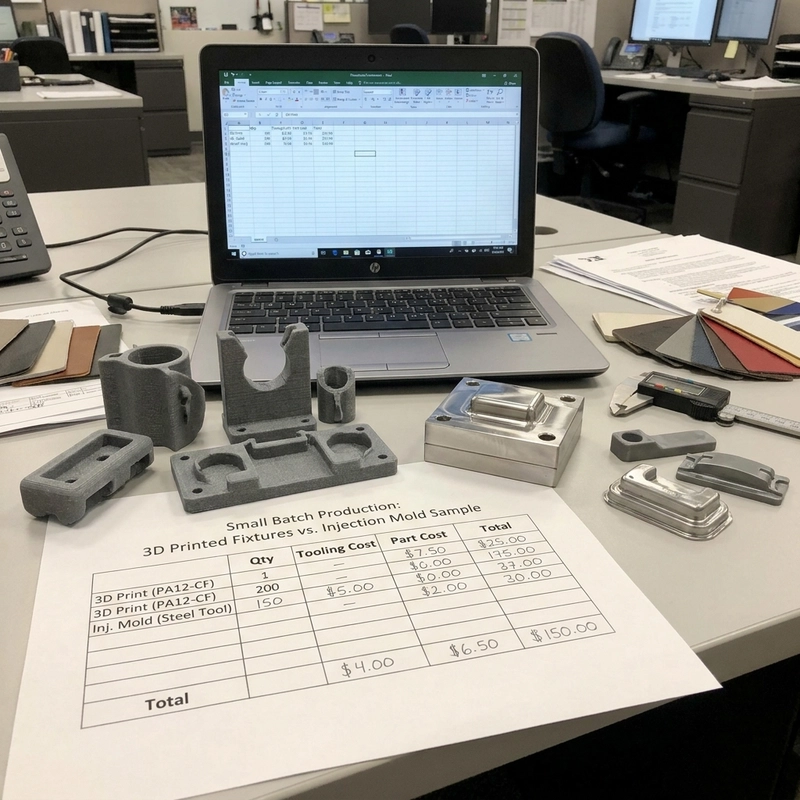
I do not treat printing as automatically cheaper. It is cheaper when the batch is small, the design is still changing, tooling would be slow, or the geometry is not friendly to molding. It becomes expensive when the part is large, dense, heavily finished, tightly toleranced, or repeated often enough that tooling cost can be spread across many units.
Engineering plastic 3D printing cost versus mold cost
The source gives a simple ABS housing example: a 15 x 10 x 5 cm part with a mold cost around 15,000 RMB, molded unit cost around 10 RMB, and FDM printed unit cost around 80 RMB. At 100 pieces, injection molding would be about 16,000 RMB, while printing would be about 8,000 RMB. At 500 pieces, injection molding would be about 20,000 RMB, while printing would be about 40,000 RMB. The break-even lands near 190 pieces in that example.
Those numbers are not universal. Mold complexity, resin grade, finish, tolerance, location, labor, and lead time change the math. The example is still useful because it shows the pattern. Printing wins when tool cost dominates. Molding wins when quantity is high enough and the design is stable.
If the design is not frozen, I would be careful with early tooling. A printed batch of 20 or 50 may cost more per piece, but it can catch mounting errors, user-fit problems, heat issues, and assembly mistakes before money is locked into steel or aluminum tooling. That learning has value, even though it does not show up as material cost.
What drives engineering plastic 3D printing cost
Material cost is visible, but build time is often worse. A large solid PETG part ties up a printer for many hours. A nylon powder-bed batch needs nesting, cooling, depowdering, powder refresh control, and cleanup. High-temperature plastics may require drying, enclosed machines, slow printing, and more failed attempts before the process is stable.
The source gives a cost breakdown example for 100 PA6 fixtures: material around 60%, equipment around 20%, and post-processing plus other labor around 20%. I would read that as a reminder, not a fixed formula. A rough shop fixture may need little finishing. A painted enclosure may flip the cost structure because sanding, filling, primer, and color control become labor-heavy.
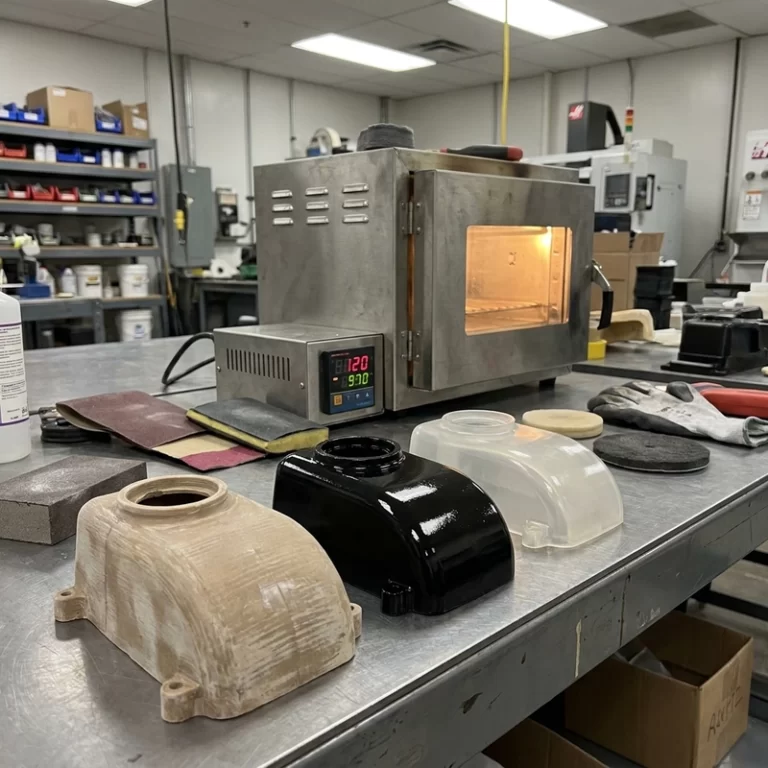
Post-processing is where cheap quotes can become expensive. Heat-set inserts, tapping, drilling, vapor smoothing, sanding, coating, annealing, dyeing, and inspection each add time. If a quote ignores those steps, the printed blank may be cheap and the finished usable part may not be.
Design choices that lower engineering plastic 3D printing cost
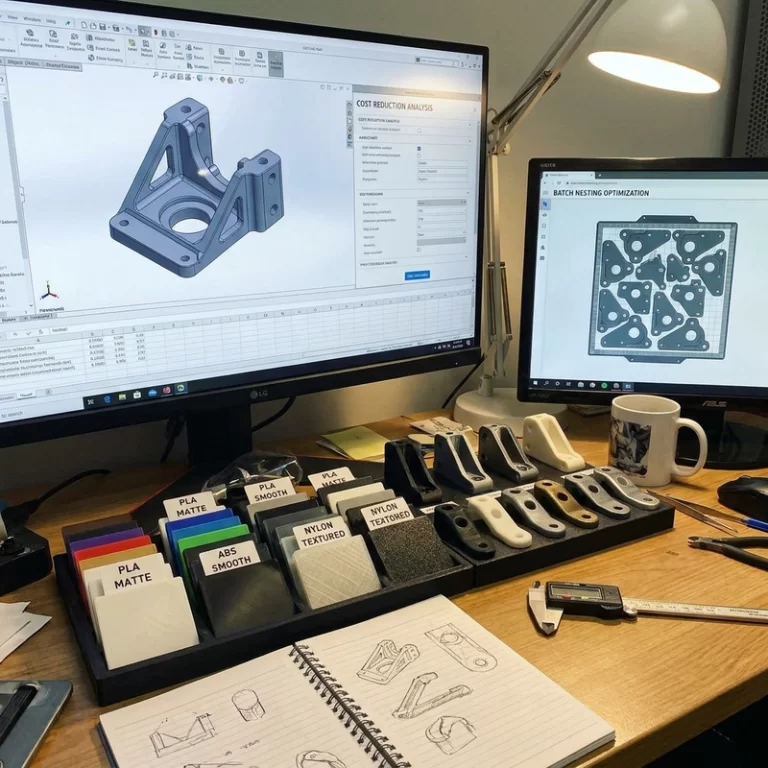
Cost reduction usually starts in CAD. Hollow thick blocks where strength allows it. Replace solid masses with ribs. Avoid huge flat panels that warp and require reprints. Split large models when segmentation reduces support, failure risk, or shipping damage. Open trapped cavities so powder or support can be removed. Mark only truly critical dimensions for post-machining instead of demanding tight tolerance everywhere.
The Zesmir article on 3D printing cost reduction goes deeper into design, material, batch quantity, and finishing choices. If the comparison is really between printed plastic and urethane or silicone-cast parts, the vacuum casting vs 3D printing article is the more relevant decision page.
Material choice also changes cost. A lower-cost plastic that meets the temperature and load requirement is better than an impressive material that creates drying problems, failed builds, or slow post-processing. The material selection logic in engineering plastic 3D printing material selection should come before the cost estimate, not after.
Small batch cost is also a risk question
For 1-10 pieces, engineering plastic printing is often the cleanest route because no tooling is needed. For 20-200 pieces, the answer depends on geometry and finish. For 500 pieces and above, I start asking whether molding, vacuum casting, CNC machining, sheet fabrication, or a hybrid route is more sensible. There is no magic quantity, only a cost curve.
Risk changes the curve. If the part is a fixture used inside a factory, appearance may not matter and printing can stay cheap. If the part is a consumer-facing enclosure, finishing and consistency may dominate. If the part has threaded inserts and tight assembly, the cost of rework can exceed the print cost. If the part needs food, medical, flame, or safety compliance, do not treat a printed sample as production-qualified without the required documentation.
Shipping can also move the final number. Large printed plastic parts may need segmentation, bonding, foam protection, or separate packing to avoid edge damage. A quote that looks cheap at the print stage may become less attractive if every part needs hand wrapping and repair after transit.
For process vocabulary and a neutral view of additive manufacturing families, the NIST additive manufacturing page is a useful external reference. It helps keep cost discussions grounded when comparing extrusion, powder-bed fusion, and other routes.
RFQ notes for a realistic cost estimate
Send the quantity range, target material, finish level, critical dimensions, insert or thread needs, expected load, heat exposure, and whether the design is frozen. If you are comparing against molding, include the expected lifetime quantity, not only the first order. Engineering plastic 3D printing cost can be very attractive, but only when the quote covers the finished part and the real batch plan.