Metal powder preprocessing happens before the build starts, but it often decides whether the build behaves. Drying, sieving, blending, storage control, and reuse records are not paperwork decorations. They reduce porosity, poor spreading, oxidation, contamination, and batch-to-batch surprises.
When I see a metal print with pores, streaky layers, rough surfaces, or inconsistent density, I do not blame the laser first. I ask what happened to the powder before it reached the machine. That quiet preparation step is easy to skip in the quote conversation.
Metal powder preprocessing starts with drying
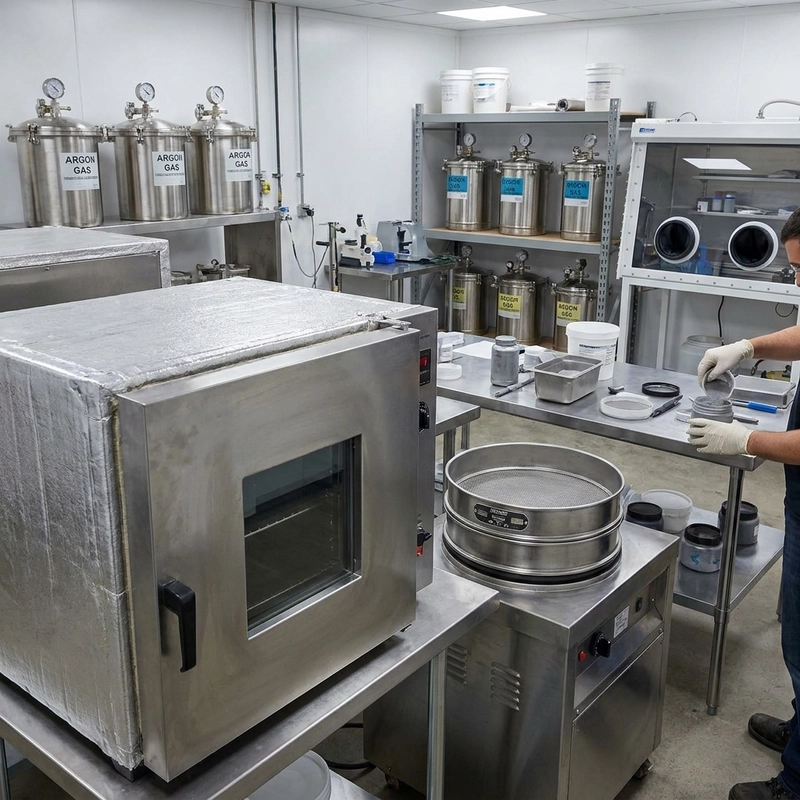
Moisture is dangerous in laser melting because it can vaporize and contribute to gas pores or spatter. Source notes included Ti6Al4V powder dried around 120 deg C for about 3 hours and 316L stainless powder around 80 deg C for about 2 hours. Those are useful examples, not a license to invent a cycle. The powder supplier and process owner should define the real drying condition.
Drying also has a handling problem. If powder is dried and then left open in humid air during a long setup, the benefit can fade. I want to know how powder is transferred, how long it sits open, and whether sealed containers or inert storage are used when the alloy is sensitive.
Sieving is not optional housekeeping
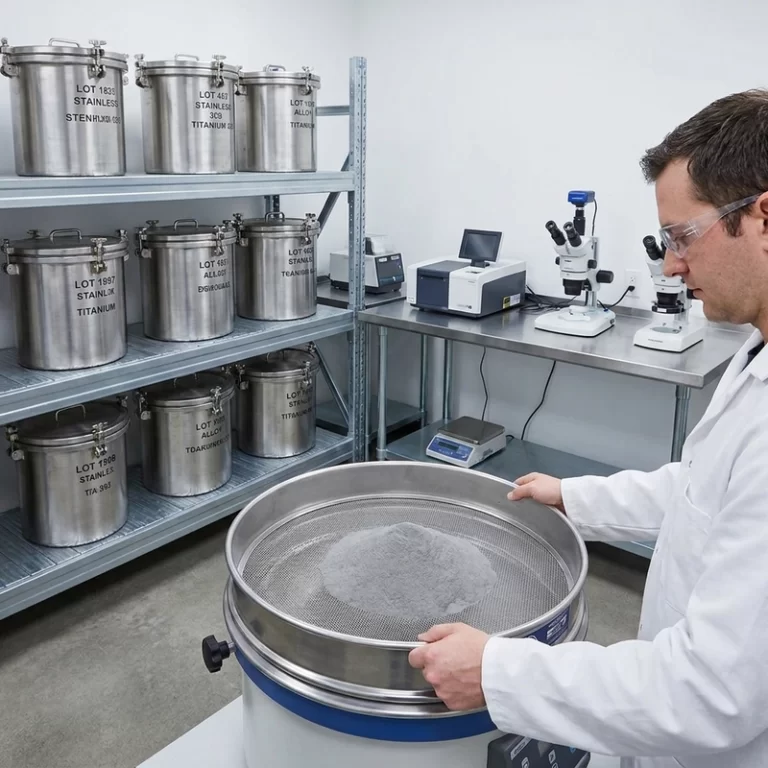
Sieving removes oversized particles, clumps, spatter, and foreign matter. Source workflows referenced 100-200 mesh or 200 mesh screening depending on powder and process. The exact mesh should follow the powder and machine requirement, but the reason is simple: uneven powder creates uneven layers.
Recovered powder needs this step even more. It may contain partially fused particles or spatter from the previous build. If those particles return to the bed, they can scratch the recoater, disturb the powder layer, or become local defects. The article on metal 3D printing powder quality covers the buyer-side risk.
Metal powder preprocessing should leave a record
I like simple records: powder lot, drying condition, sieve step, virgin-to-reused blend rule, storage condition, and any oxygen or moisture checks used by the workflow. Without records, it is hard to explain why a second batch behaves differently from the first one.
This matters most for titanium, nickel alloys, and functional stainless parts. A display sample and a load-bearing bracket do not need the same documentation, but the quote should say which level is being supplied. For SLM parameter context, see SLM parameter optimization.
Storage and handling are part of metal powder preprocessing
Good drying and sieving do not help if the powder is handled with dirty tools, left open in humid air, or mixed with another alloy by mistake. I want containers labeled, sealed, and separated by material. Titanium powder, stainless powder, and nickel alloy powder should not share casual handling equipment without a cleaning rule.
Recovered powder also needs a decision point. Some powder can go back into production after screening and blending. Some should be downgraded to non-critical work. Some should be removed from use. The decision should come from process rules and inspection, not from a desire to avoid waste.
For an RFQ, the buyer does not need every shop record, but the buyer can ask whether metal powder preprocessing is controlled for the alloy and application. A prototype bracket, a decorative part, and a pressure-related component should not be treated with the same powder documentation.
The preprocessing route may also differ between SLM and binder jetting. SLM is sensitive to spreading, melt stability, oxygen, and spatter. Binder jetting is sensitive to powder packing, binder interaction, depowdering, and sintering behavior. The same alloy name does not mean the same preparation rule.
I also check timing. Powder that was dried last week and opened several times is not the same as powder dried and sealed for the build. Powder recovered from a hot build and rushed back into use is not the same as powder screened, cooled, blended, and recorded. Metal powder preprocessing is a chain, and the weakest handling step can undo the earlier care.
If a part is critical, ask for a process note with the powder lot and reuse status. If it is a rough fit sample, a lighter note may be fine. The important thing is that the level of control matches the risk of the part.
One more detail: preprocessing should happen close enough to the build to matter. A clean sieve record from a previous week is not useful if the powder has been handled badly since then. Metal powder preprocessing should be tied to the actual build, not kept as a generic shop claim.
For repeat orders, I would keep the same preprocessing checklist beside the approved sample record.
| Step | Risk it reduces | What to confirm |
|---|---|---|
| Drying | Moisture-driven porosity | Cycle and handling after drying |
| Sieving | Clumps and oversized particles | Mesh or screening rule |
| Blending | Reuse inconsistency | Virgin/reused powder ratio |
| Storage | Humidity and contamination | Sealed or inert handling |
| Records | Untraceable batch drift | Lot and reuse history |
NIST additive manufacturing is useful for general process language. In the shop, metal powder preprocessing is more concrete: dry the powder correctly, screen what comes back, store it cleanly, and do not pretend reused powder has no history.