SLS and MJF nylon 3D printing looks simple from the outside: upload a file, fill a powder bed, pull out the parts. On real nylon jobs, the unstable part is not usually the CAD upload. It is the powder history, the drying condition, the nesting plan, and the amount of cleanup the part can tolerate after the build.
I do not like judging SLS or MJF only by the quoted unit price. In SLS and MJF nylon 3D printing, a low price can hide an aggressive powder reuse plan, a very dense build, or a raw surface finish that still needs dyeing, tumbling, sealing, tapping, or local machining. For brackets and fixtures that may be fine. For a visible product sample or a repeat batch of clips, the same shortcut can show up as rough texture, color shift, trapped powder, loose fits, or brittle edges.
How MJF 3D Printing Works in a Real Part Workflow
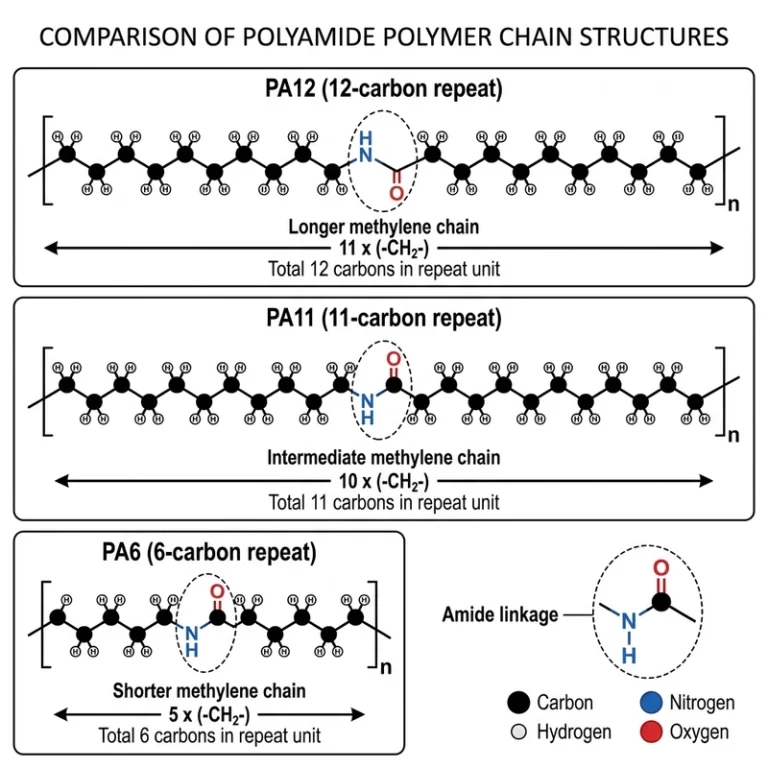
SLS uses a laser to sinter polymer powder. MJF uses fusing and detailing agents with infrared energy. Both sit inside the powder-bed fusion family, and both are commonly used with nylon such as PA12 and PA11. That shared powder-bed behavior is why buyers often group the two processes together.
The important difference is not a slogan like “SLS is flexible” or “MJF is faster”. It is how the build handles heat, powder, agent distribution, part spacing, cooling, and post-cleaning. If the part is a thick housing, a small snap-fit latch, a thin duct, or a nested run of hundreds of small parts, those details matter more than the process label.
When I review an RFQ for SLS and MJF nylon 3D printing, I normally mark four areas before thinking about the final price: material grade, powder refresh control, build layout, and finish expectation. If any one of those is vague, the first sample may still look acceptable, but repeat production becomes harder to trust.
Powder refresh is not just a cost trick
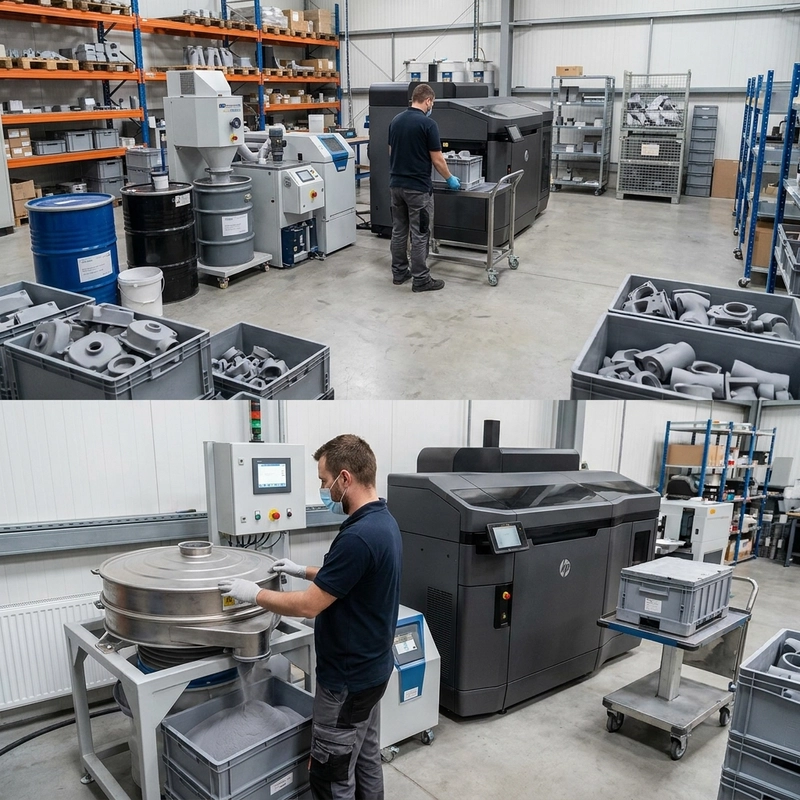
After a powder-bed build, only part of the powder becomes solid parts. The surrounding powder supports the geometry during printing, then it is recovered during depowdering. Some recovered powder can be screened and blended back with virgin powder. That is normal practice. The problem starts when “reused powder” is treated as if it has exactly the same behavior as new powder.
Powder that has sat through a build has seen heat. It may also have absorbed moisture during storage or handling. Flowability, color, particle condition, and sintering behavior can change. I would not copy a powder refresh ratio from a forum post and treat it as a universal rule. The correct blend depends on the material supplier, machine process, part requirement, and whether the batch is a rough fixture or a cosmetic product component.
A practical check is simple: ask whether the refresh ratio is controlled for repeat batches, and whether aged powder is screened, dried, and kept away from critical jobs when needed. For SLS and MJF nylon 3D printing, if the answer is only “we reuse powder to reduce cost”, that is not enough for functional nylon parts. It does not mean the supplier is bad. It means the quote is missing a quality-control detail.
Moisture control matters before the powder reaches the bed
Nylon absorbs water. That is true for filament, pellets, and powder. Excess moisture can contribute to bubbles, rough surfaces, weak areas, and dimensional drift. The exact drying condition should follow the material supplier’s datasheet, not a guessed temperature from another nylon grade.
This is why I link moisture control with powder refresh. A clean refresh plan still fails if storage is sloppy. For a deeper material-side check, I would pair this article with Zesmir’s notes on nylon 3D printing moisture control and PA12 nylon 3D printing. The buyer does not need to become a powder chemist, but the buyer should know what to ask before approving repeat work.
Nesting changes the batch, not only the invoice
One reason SLS and MJF can be cost-effective is nesting. Many parts share one build volume, and no separate support structure has to be printed and removed in the same way as resin or FDM. That is a real advantage for small-batch production.
Still, maximum packing is not automatically the best build. Thick sections hold heat differently from thin ribs. Large flat faces can behave differently from small clips. In SLS and MJF nylon 3D printing, a batch that mixes heavy housings with delicate snap features may cool unevenly. The result can be slight warping, surface variation, loose hole size, or one corner of the build looking different from another.
I normally want the nesting plan to respect part size, wall thickness, heat distribution, and depowdering access. If hollow parts or lattice structures are included, escape holes cannot be an afterthought. Powder trapped inside a closed cavity is not a small cosmetic issue if the part is going into a product, a fixture, or a moving assembly.
| Control point | What can go wrong | What I would ask before approval |
|---|---|---|
| Powder refresh | Rougher texture, color variation, weaker or less repeatable parts | Is the refresh ratio recorded for repeat batches? |
| Powder storage | Moisture-related defects, poor flow, unstable finish | How is PA powder dried and sealed before use? |
| Nesting density | Uneven heating, distortion, mixed surface appearance | Will thick and thin parts be built together? |
| Depowdering | Powder left inside channels, blind holes, lattice areas | Are escape holes and cleaning access designed into the model? |
| Finish route | Raw texture does not match buyer expectation | Is the quote raw, dyed, tumbled, sealed, painted, or machined? |
SLS and MJF nylon 3D printing surface checks
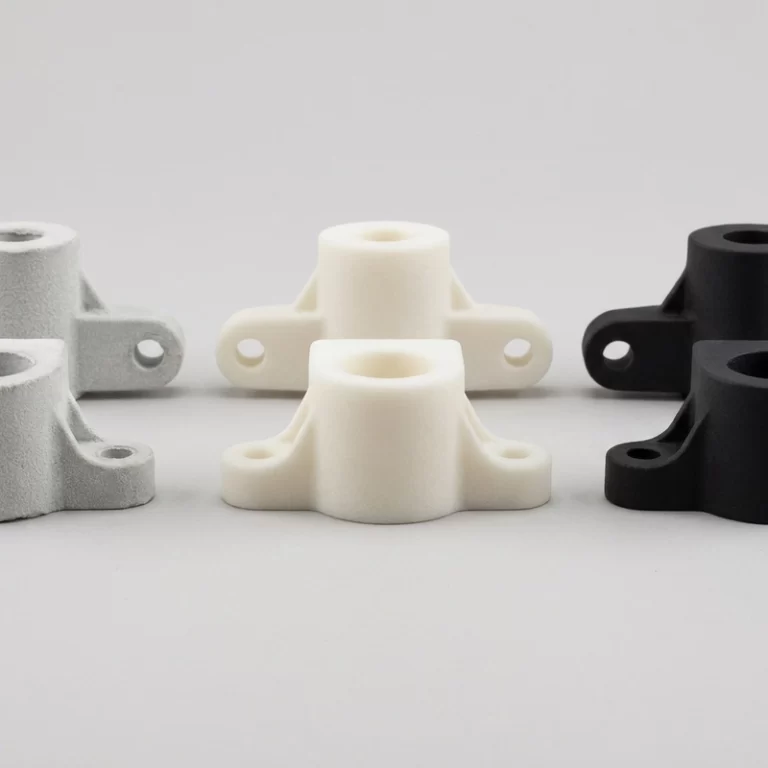
Raw nylon from SLS and MJF usually has a fine powdery texture. That texture is normal. It is also easy to misunderstand. A fixture, robotic bracket, duct, or hidden housing may not need more than depowdering and bead blasting. A handheld product part may need dyeing, tumbling, sealing, coating, or local machining. A gift sample with a logo may need a different inspection plan again.
Do not approve a cosmetic nylon batch from photos alone if the surface matters. Photos hide powder texture, edge softness, and small color shifts. A small finish sample is often a better control than a long email chain. For SLS and MJF nylon 3D printing projects with visible surfaces, the related draft on SLS nylon surface finishing is the better place to go deeper.
Threads, holes, bearing seats, sealing faces, and press-fit zones need separate attention. Printing may create the general shape, but the final function may require tapping, threaded inserts, drilling, reaming, or CNC cleanup. I would rather mark those features in the STEP file than let the shop guess which holes are cosmetic and which holes must assemble with hardware.
SLS and MJF nylon 3D printing is not a mold texture replacement
This is a common expectation problem. Nylon powder-bed parts can be strong and useful, but the raw surface is not the same as injection molding. If the buyer wants a molded-looking outer shell, the quote should include finishing work or a different manufacturing route. If the buyer wants functional low-volume parts, raw or dyed nylon may be the practical choice.
How I would prepare an RFQ for repeat nylon batches
The best RFQ is not long. It is specific. Send STEP when geometry and dimensions matter, STL when the mesh is all you have, and mark any areas that must fit with screws, shafts, clips, seals, or other printed parts. Add the target material, quantity, color, finish, and whether the first order is a prototype, a fixture, a sales sample, or a repeat production batch.
For process comparison, I would also keep Zesmir’s MJF 3D printing quality control article nearby. For basic powder-bed terminology, the NIST additive manufacturing resource is a neutral external reference. It is useful for vocabulary, not a replacement for checking the actual material datasheet and supplier process notes.
My final check is blunt: if SLS and MJF nylon 3D printing is being used for a one-off visual model, surface expectation matters most. If it is being used for a repeat functional batch, powder refresh, drying, nesting, depowdering, and inspection matter more than the cheapest line item on the quote.